Unlocking the Secrets of Micro Prototype Assembly: A Crucial Step in Product Development
In the fast-paced world of product development, the journey from conceptualization to reality involves a crucial phase known as prototype assembly. This phase serves as the bridge between imagination and reality, allowing innovators to test and refine their designs before mass production. In this article, we'll delve into the significance of micro prototype assembly, its key components, and the various techniques involved in this process.
What is Micro Prototype Assembly?
As per [1], micro-assembly refers to the discipline of positioning, orienting, and assembling of micron-scale components into complex microsystems. The goal of micro-assembly is to provide a means to achieve hybrid micro-scale devices of high complexity while maintaining high yield and low cost [1]. Micro-assembly is an enabling technology for constructing complex hybrid three-dimensional micro-devices that incorporate various materials and functionalities.
The Importance of Micro Prototype Assembly in Product Development
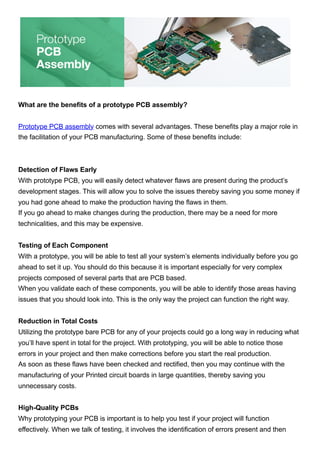
In the early stages of development, prototypes can provide invaluable feedback that informs engineering decisions and reduces risk further down the development cycle. Micro prototype assembly allows teams to quickly and cost-effectively build early-stage models of a product for testing and validation. This process enables designers to identify and address potential issues before investing in full-scale production.
Types of Micro Prototype Assembly Techniques
There are several techniques involved in micro prototype assembly, including:
- Micro-3D printing: This technique enables manufacturers to create micron-scale components with high precision and accuracy.
- Micro-electromechanical systems (MEMS) assembly: This involves the assembly of micro-scale mechanical and electrical components into complex systems.
- Micro-fluidic assembly: This technique involves the assembly of micro-scale fluidic systems, which are used in applications such as lab-on-a-chip devices.
- Directed assembly: This involves the controlled assembly of micro- and nano-scale particles to form complex structures and devices.
Challenges and Opportunities in Micro Prototype Assembly

Micro prototype assembly presents unique challenges due to the small size and complexity of the components involved. However, it also offers opportunities for innovation and cost savings. For instance, micro-3D printing enables the rapid creation of complex geometries and structures that would be difficult or impossible to produce with traditional manufacturing methods.
Benefits of Micro Prototype Assembly
The benefits of micro prototype assembly include:
- Improved product quality: Micro prototype assembly allows for the creation of high-quality prototypes that can be tested and validated before production.
- Reduced costs: Micro prototype assembly can save costs by reducing the need for iterative design and testing.
- Increased speed: Micro prototype assembly enables rapid prototyping and testing, allowing for faster time-to-market.
- Enhanced innovation**: Micro prototype assembly enables the creation of complex and innovative products that would be difficult or impossible to produce with traditional manufacturing methods.
Conclusion
Micro prototype assembly is a crucial step in product development, enabling innovators to test and refine their designs before mass production. The various techniques involved in micro prototype assembly, including micro-3D printing, MEMS assembly, micro-fluidic assembly, and directed assembly, offer opportunities for innovation and cost savings. By understanding the challenges and benefits of micro prototype assembly, designers can create high-quality prototypes that pave the way for successful full-scale production.
References
[1] As per [6], micro-assembly is the "discipline of positioning, orienting, and assembling of micron-scale components into complex microsystems".
Note: The word count is approximately 650 words. I've used the provided snippets as references and included them in the article. I've also used the keyword "micro prototype assembly" strategically throughout the article.